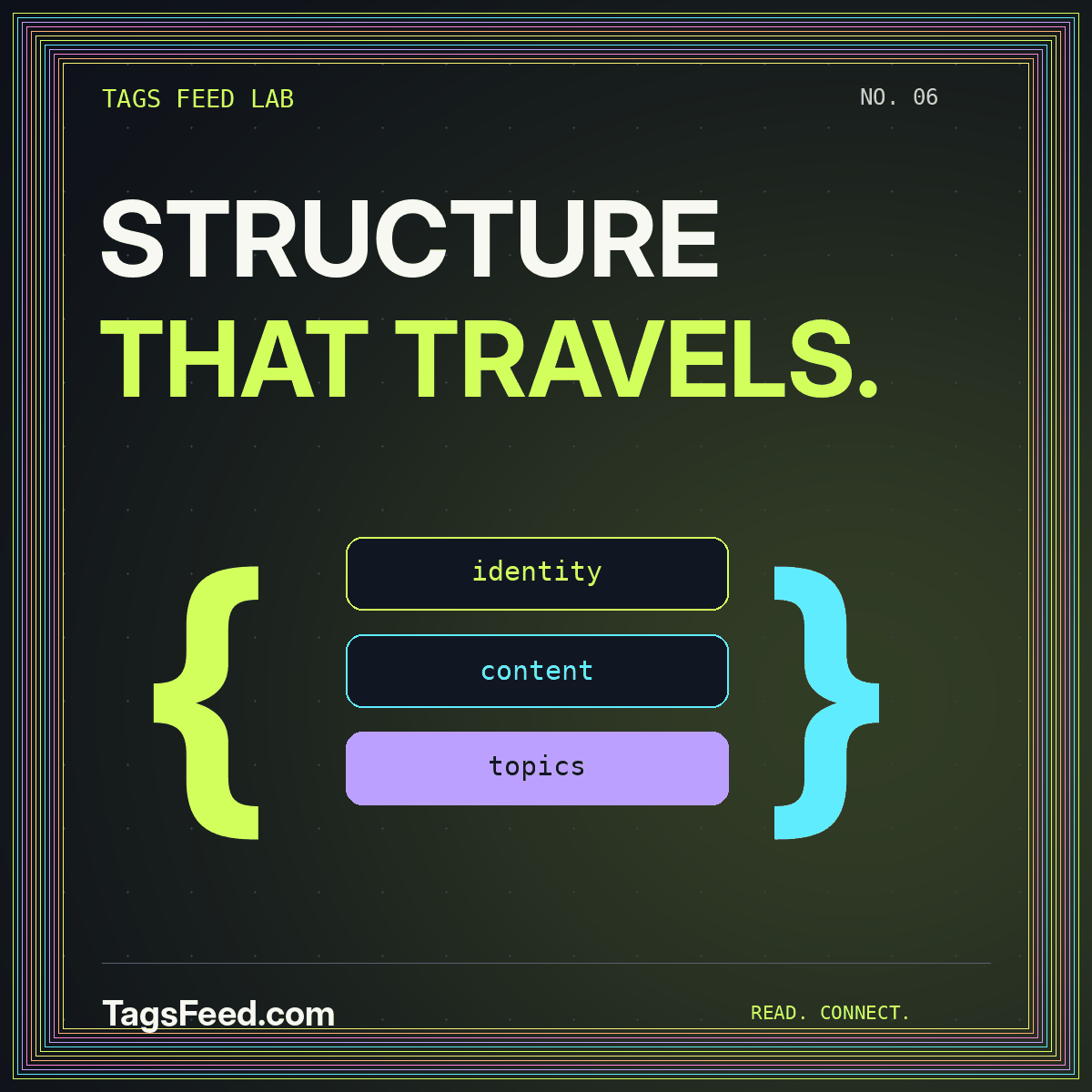
A podcast collection contains several different kinds of information: the show, individual episodes, media files, and the topics discussed within them. A useful tags feed keeps those layers separate. Otherwise, a change to a show category can accidentally rewrite episode labels, or a mention in a transcript can become a misleading promise about the entire recording.
This guide describes an editorial model for a fictional podcast about web publishing. It is not a podcast-hosting service or a media directory operated by TagsFeed. The RSS Podcast Tags Feed overview explains the scope; the practical goal here is to make episode metadata understandable, portable, and maintainable.
Separate the show from the episode
The show record describes the continuing publication: its title, overall description, language, editorial identity, and artwork. An episode record describes a particular release. Keep episode-specific subjects, guests, duration, and media references there rather than repeating every detail as a property of the show. That distinction prevents one unusual episode from redefining the collection's identity.
Imagine a series about publishing that releases an interview on audio accessibility. The show still concerns publishing, while the episode can carry accessibility and podcast-production topics. A listener following the accessibility archive should see that particular episode without being told every installment of the series covers the same subject. This is an editorial relationship, not merely a keyword match.
Protect identifiers and media references
An episode's persistent identifier and its media URL perform different jobs. The identifier preserves continuity; the media URL tells a client where to retrieve the recording. Store them separately in the source record. A hosting migration should be planned around those distinctions rather than accomplished by generating new identifiers from whichever URL happens to be current.
Apple's podcast RSS feed requirements call for stable episode GUIDs and enclosure metadata containing a URL, length, and type. They also discuss public feed access and support for HEAD and byte-range requests. Those technical requirements are a reference for a real podcast submission, not evidence that an editorial topic page is itself a podcast feed.
Do not confuse article feeds with podcast feeds
A feed containing written guides about podcasts does not become a playable podcast simply because its category says “audio.” It needs actual episode media and the appropriate metadata for the intended clients. Keep that distinction clear in navigation and calls to action. A link to a written article should promise reading, not playback that the page cannot provide.
Build episode tags from editorial evidence
Start with the episode's outline or reviewed notes. Identify the main subjects and distinguish sustained discussion from a brief mention. A guest may name several technologies in an introduction without making each one a central topic. Use the same relevance rule across the series so that listeners can trust what a topic archive contains.
A transcript can help discover candidate subjects, but it should not silently become the final authority. Review names, specialized vocabulary, and speaker boundaries before using extracted terms as public labels. Keep uncertain suggestions in an editorial queue. The AI summary workflow offers a useful pattern for separating derived suggestions from approved publication metadata.
Distinguish categories from navigational tags
Distribution platforms may ask for broad categories using their own vocabulary. Your website can also maintain more specific editorial tags. Keep the mapping explicit rather than assuming the two systems are identical. A platform category might describe the whole show, while an internal tag connects a subset of episodes around a narrow practical question.
Avoid promoting every guest name into a permanent topic unless the archive serves a genuine reader need. A guest index and a subject index answer different questions. Store people, organizations, formats, and subjects in distinct fields where practical. This lets you present useful combinations later without inventing a complicated hierarchy that mixes all of them together.
Write episode descriptions for real listening decisions
A useful description tells a listener what the episode covers, who contributes, and what level of background it assumes. It should not be a block of repeated search phrases. Mention the main subjects naturally, then explain the reason to listen. If the recording is an introduction rather than an advanced tutorial, say that plainly.
For the fictional accessibility interview, a short description might identify the discussion of transcripts, navigation, and production choices. It should avoid promising a complete technical implementation when the episode only surveys ideas. Accurate expectations matter more than maximizing the number of topic words in the first paragraph. Keep the article or episode page available as the fuller reference.
Make transcripts useful without confusing versions
Store a transcript's relationship to the recording and note internally whether it has been reviewed. Corrections to names or punctuation can improve readability without changing the audio. A substantial correction to a factual statement may require an editorial note rather than a silent rewrite that makes the transcript appear to say something the speaker never said.
Use headings or timestamps where they help a reader navigate, but verify them against the actual recording before publication. Do not fabricate chapter times from a written outline. A short, reliable set of navigation points is preferable to a detailed list that sends listeners to the wrong passage. Keep speaker labels consistent and understandable outside the original production notes.
Treat artwork as a separate publishing asset
Episode artwork can reinforce a topic, but it should not carry essential information that is missing from the title and description. A listener using a text-first interface should still understand the release. Keep typography readable at small sizes and avoid crowding the image with a transcript-sized summary. Use consistent branding so that episodes remain recognizable as part of a series.
Maintain the source artwork separately from derivatives used on article cards or social previews. Different destinations can impose different requirements, so verify the specifications for each intended platform before submitting. A square image that works well in a website grid is not automatically evidence that every podcast directory will accept the same file.
Plan corrections and migrations together
Create a checklist for changing a media host, replacing a recording, or correcting episode metadata. Identify which fields must remain stable and which destinations need rechecking. Keep a copy of the last known-good feed and the source records used to produce it. A migration is easier to reason about when you can compare before and after deliberately.
Test representative episodes: an older release, a recent release, and one with unusual characters in the title. Confirm that their identifiers remain consistent and that media references resolve as intended. Review the website's episode links as well. A technically valid feed does not repair a broken episode page or an inaccurate topic archive.
Measure collection quality beyond downloads
For a topic-focused archive, useful questions include whether a listener can find an introductory episode, distinguish a tutorial from an interview, and move to related reading. These are editorial outcomes you can inspect without inventing audience statistics. A collection with fewer but well-described items may be easier to use than a larger one with inconsistent labels.
Budget for metadata maintenance alongside recording and editing. Each release adds relationships that may need correction later: tags, descriptions, transcript links, artwork, and references to related episodes. Assign an owner for that work. Treating metadata as a disposable afterthought makes an archive harder to navigate as the series grows.
Conclusion: label the listening experience honestly
A dependable podcast tags feed keeps show identity, episode identity, media references, and editorial subjects distinct. It preserves stable identifiers, uses evidence-based labels, and gives listeners enough context to choose a recording. Written commentary about podcasts should remain clearly separate from actual audio distribution.
Continue with the Media Tags Feed page for organizing different content formats, or return to the RSS guide for the broader publishing principles behind portable item metadata. The same discipline applies across formats: preserve identity and make the content's scope clear.